About Me

My photo
New York, New York, United States
Mostly visual art and air guitar.

Back Issues

Showing posts with label Ansel Adams. Show all posts

Monday, March 11, 2013

摸魚~ Fumbling For Fish. II

    Did a Google search for similar visuals and found that this technique has already been attempted, so apparently it's something called scanography.

    Since basic principles with the "Appetite for Creation" series include a mechanical eye recording lines of reflected information and interrupting its predictable motions via human involvement, it then became an experimental search for suitable subject matter.

Temple roof in Taiwan. (click to enlarge)

Temple roof in Taiwan. (click to enlarge)

Temple roof in Taiwan. (click to enlarge)

Temple roof in Taiwan. (click to enlarge)

    Note: All images are *not* created with digital manipulation software (i.e. Adobe Photoshop) for composition and content.

Wednesday, March 6, 2013

摸魚~ Fumbling For Fish.

    This new project involves techniques and ideas derived from the previous series, - "Appetite for Creation" - and utilizes a newer yet similar form of technology.

X'mas in New Jersey, late 1990s. (click to enlarge)

UMBC in late 1990s. (click to enlarge)

UMBC in late 1990s. (click to enlarge)

X'mas in New Jersey, late 1990s. (click to enlarge)

     Note: All images are *not* created with digital manipulation software (i.e. Adobe Photoshop) for composition and content.

Tuesday, April 3, 2012

Appetite for Creation Part 10: Just Flaws

        "An ancient tenet in Chinese painting holds that the Master paints not the created thing, but the forces that created it."
        - Art and Fear: Observations on the Perils (and Rewards) of Artmaking 

    One great thing about making art is how the results never lie to the creator - by evaluating the techniques, ideas and materials of a finished piece, success and/or failure is transparently evident for the viewer to perceive. Being one's own worst critic can be a tricky strategy: since no piece of art or body of work can ever be perfect, this reality can cause the artist to either abandon such futile pursuits or lose sight what "perfection" may actually be.

        "Ansel Adams, never one to mistake precision for perfection, often recalled the old adage that 'perfection is the enemy of the good', his point being that if he waited for everything in the scene to be exactly right, he'd probably never make a photograph."
        - Art and Fear

    While many elements are far beyond the control of the artist, it is the familiarity of techniques, knowledge of materials and detail of ideas that one must bring to bear with as much certainty as possible in order to best capture the time, place and mindset when a piece of art achieves not perfection, but authenticity and truth.


03-10-12: Skywalk in Rego Park, NY (click to enlarge)

03-10-12: Skywalk in Rego Park, NY (click to enlarge)

03-11-12: Parking Lot Lamp in Flushing, NY (click to enlarge)

03-11-12: Windmill in Flushing, NY (click to enlarge)

03-11-12: Windmill in Flushing, NY (click to enlarge)

03-11-12: Windmill in Flushing, NY (click to enlarge)

    Doing the best we can with what we have should be no less than the world comes to expect from artists of every stripe.

    Note: The above images are taken directly from a Samsung SCH-u540 camera/phone with no processing or manipulation.

Friday, March 16, 2012

Appetite for Creation Part 9: Human Seeing

    Surrealism has always been a subject of enduring interest - while it has many definitions according to various perspectives, the one that comes to mind most often is: making what is familiar look unfamiliar. Cubism is another field that continues to make sense; the idea of combining multiple views into a single frame is not so bizarre if one considers the adage that walking in the shoes of another will help broaden horizons.

    Making art is risky because it exposes and elaborates on some of the most personal issues that will not always garner the response that an artist hopes for. Effective art is whatever that can create dialogue, spur intellect, solicit opinions and change minds. Each and every person who pursues art can bring about such effects as long as they do not give up hope in seeking to comprehend one of the greatest mysteries of all time: the meaning and purpose of life itself.

03-03-12: Steel gate in Woodside, NYC (click to enlarge)

03-03-12: Steel fence in Woodside, NYC (click to enlarge)

03-06-12: Archway in Sunnyside, NYC (click to enlarge)

03-06-12: Archway in Sunnyside, NYC (click to enlarge)

03-06-12: Archway in Sunnyside, NYC (click to enlarge)

03-06-12: Archway in Sunnyside, NYC (click to enlarge)

03-06-12: Archway in Sunnyside, NYC (click to enlarge)

   The answers we get depend upon the questions we ask, and trying to find a right answer to our own dilemmas is certainly worth the price of a lifetime's devotion to understanding the human psyche through art.

    Note: The above images are taken directly from a Samsung SCH-u540 camera/phone with no processing or manipulation. 

Sunday, March 11, 2012

Appetite for Creation Part 7: More Than Treats The Eye

    Producing art can be a rush, an obsession, an addiction. The moment when concept, execution and luck all meld together harmoniously to realize one's efforts is a thrill that only an artist will truly enjoy; critics rarely see the events leading up to an subjective offering and thus can merely provide superficial judgments on what little they immediately experience.

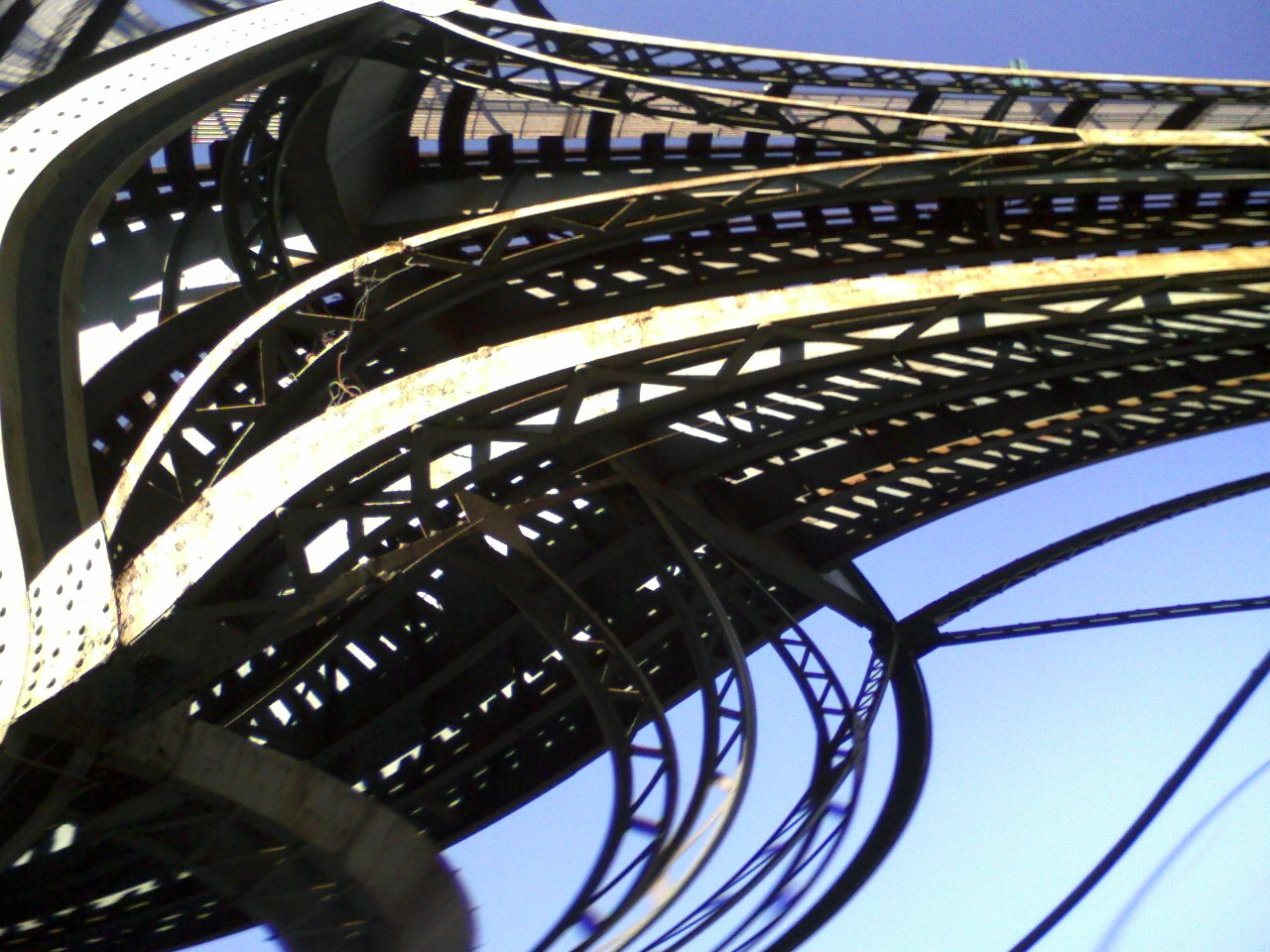
02-18-12: Elevated subway tracks in Woodside, NYC

02-18-12: Elevated subway tracks in Woodside, NYC

02-18-12: Elevated subway tracks in Woodside, NYC

02-27-12: Elevated subway tracks in Woodside, NYC

02-27-12: Elevated subway tracks in Woodside, NYC

02-27-12: Elevated subway tracks in Woodside, NYC

02-27-12: Elevated subway tracks in Woodside, NYC

    What matters most is not to look and see that a camera was there, but that an artist was there.

Thursday, March 1, 2012

Appetite for Creation Part 6: The Evolution Will Not Be Televised

    Art is the voice of the human soul - whether to sing out loud alone or for others to experience, those that can accept and/or appreciate a genuine link between intuition and tangibility will stand to gain a broader view of the world even if the audience should consist solely of the artist.

    Initially, an artist's education is comprised of learning how to do things "the right way" - from basic principles to intermediate developments to advanced techniques, more often than not these are required steps by which ideal results can be achieved. And when the artist has secured their grasp of concepts that have proven effective over decades, centuries or even millennia, they are then free to utilize such reference points in finding a particular path most suitable to individual reflections.

    There are many reasons why one chooses to create art. With this particular series of pictures made by a Samsung SCH-U540 phone, envisioning the world through digital technology became a natural course of action after playing around on the camera yielded progressively more tantalizing glimpses of its potential as an artmaking tool. As posted before, trying to stave off boredom planted the seed of an idea that unusual applications of modern imaging equipment could prove worthy of continued exploration as a valid method of visual expression.

01-07-12: Columbus Circle in Manhattan, NYC

01-07-12: Columbus Circle in Manhattan, NYC

01-07-12: Columbus Circle in Manhattan, NYC

01-07-12: Columbus Circle in Manhattan, NYC

01-07-12: Columbus Circle in Manhattan, NYC

02-14-12: Roosevelt Avenue in Elmhurst, NYC

02-14-12: Roosevelt Avenue in Elmhurst, NYC

    Stop just looking at things and start seeing the environment with your own mind's eye - simply accepting what society has deemed as the norm will never lead to real freedom.

Saturday, January 7, 2012

Appetite for Creation Part 4: Comfortably Dumb

        "Old work tells you what you were paying attention to then; new work comments on the old by pointing out what you were not previously paying attention to."
         - David Bayles and Ted Orland, Art and Fear: Observations on the Perils (and Rewards) of Artmaking

             
    It has been said that those who do not study history are doomed to repeat past mistakes. Strangely though, nowadays the trend seems to be that far too many are relying on bygone successes (due in part to the woefully stunted collective memory of recent generations raised on attention-span-sapping mass media) in order to mask their own deficiencies as true innovators of original expression. Witness the current rash of Hollywood remakes/reboots/re-imaginings of established material both domestic and foreign then ask if this counts as progress. There is no doubt that a winning formula should be milked for all its worth, but sooner or later that horse will die and thus leaves one with few alternatives to being chased down by pursuing wolves or finding yet another way to keep moving forward. Sun Tzu had posited how tactics that yielded positive results before will no longer be useful in later campaigns; the same gold mine that is forever dug into eventually becomes a grave. Evolution is but a leap of faith away from extinction.

    The individual impacts that the Beatles and Nirvana had on their contemporary music scenes are just two examples of how substance will NEVER go out of style. Decades apart, each group presented monumental changes in artistic efforts which at the time (1960's and 1990's, respectively) had either only begun to be explored or already run its course. Forging distinctive identities through tectonic shifts in attitude, composition, language, etc., they shed enduring illumination on a myriad of political, social, spiritual and economic issues that lacked open dialogues on. Even though the instruments and channels of conveying such radical ideas remained fundamentally unchanged over the course of thirty years, it was undeniably evident that the reactions to and perceptions of current themes which these separate artists brought to the forefront via popular entertainment resonated with an appreciative audience. Rock and roll (born from the blues and its recurring motif of dissatisfaction with life) was once a vital catalyst in bringing about cultural upheaval, and art should continue to play the same role today.

    For good or bad, once a piece of art is born it belongs to the world - regardless of whether the finished creation was intended for personal analysis or public view, a unique contribution has been made that in its own way has altered reality for any and all who experience it. Similarly to how eighty percent of a salesperson's efforts will come to fruition only once, it is the meager one of every five attempts that proves sustainable as long as the creative juices keep flowing. In some disciplines practice might lead to overall perfection, but the trapping illusion of flawless art is one that exacerbates the fear of uncertainty and spawns countless reasons to hold back one's best work. Trial and error are essential steps toward maturity and even the powers that be can get things wrong once in a while, which explains the existence of Nickelback. No risk means no reward, and the biggest loser (besides Chad Kroeger) is always the person who neglects to try anything new or different.

9-29-11: Baltimore - Washington Parkway, MD (click to enlarge)

9-29-11: Baltimore - Washington Parkway, MD (click to enlarge)

9-29-11: Baltimore - Washington Parkway, MD (click to enlarge)
 
12-14-11: Industrial building in Long Island City, NY (click to enlarge)

12-22-11: Streetlight in Jamaica, NY (click to enlarge)

12-22-11: Streetlight in Jamaica, NY (click to enlarge)

12-22-11: Streetlight in Jamaica, NY (click to enlarge)

12-22-11: Streetlight in Jamaica, NY (click to enlarge)

    Instead of endlessly retreading familiar grounds for the sake of nostalgia, tradition and security, the most logical course of action is to leave one's comfort zone which is no better than a prison unless its inhabitant can devise a way out. An oft-used phrase states that no door is closed without a window being opened; even if it's a long way down, anyone can fly free when the right mix of wisdom, strength and courage is applied to the circumstances. This world stays flat only if the mind cannot comprehend another dimension.

Note: The images taken in this series are from a Samsung SCH-u540 phone.

Friday, October 21, 2011

No Ordinary Flash in the Panorama

    Artistic expression is the one of the most well-preserved and enduring aspects of life.  From the Lascaux cave paintings (around 18,000 years old) of the Upper Paleolithic era to the NYC Waterfalls by Olafur Eliasson (2008), works of art can reawaken, reflect and record a universal human spirit to create, inspire and evolve.  Utilizing mediums both permanent (carvings, sculptures, paintings, photography, writings, etc.) and ephemeral (dance, music, performance, consumables, etc.), artists throughout history have sought to demonstrate a wide range of uncommon talents, methods, attitudes and dreams for the benefit of complementing their respective cultural, economic and intellectual environments. 

    For example, ever since the introduction of photography in the early 1800's, many significant cultural and scientific breakthroughs in the optical imaging field continue to feed a global desire to illustrate various facets of a rapidly-developing world.  In the case of renowned photographers such as Ansel Adams, Diane Arbus, Alfred Stieglitz, Robert Capa and Cindy Sherman, this technology was essential to realizing intellectual and primal connections to the audience through content, aesthetics, intuition and metaphor.  Additionally, increased exposure of their photographic efforts was facilitated by advancements in the printing industry - as processes and materials for graphic reproduction became more affordable, a broader awareness of this innovative practice took hold in the public sphere.

    Recently, mass marketing of digital cameras and output devices have granted quite reasonable means of pursuing one's own ambitions to capture, exhibit and maintain accounts of notable persons, events and surroundings.  With a proliferation of pictures generated on a daily basis, an exponential amount of mediocrity has also affected social perception of the art; while most people no longer view photography as exclusive due to its current prevalence, lowered expectations have impacted the business to a certain degree.  Standards of visual eminence are nowadays constantly challenged as an overabundance of average results often factor into assessing the fair value of professional judgment and expertise.  Those who devote considerable time, energy, knowledge and other resources in perfecting a professional craft are inherently best equipped to produce outcomes that transcend - exercising a solid grasp of control, composition, lighting, interpretation and improvisation are key elements of a superior photograph that require years of training and dedication.  Different and changing situations necessitate mental agility, physical coordination, remarkable vision and reflexive memory in order to achieve efficient excellence preferable to unsophisticated attempts by the less initiated. 

   After the orchestration of compelling imagery, it is equally of importance to select effective substrates so as to maximize the potential of each artistic undertaking.  Even though photography is a relative newcomer in visual history, with proper conservation the lifespan of each tangible print can easily extend beyond that of its creator.  Artifacts such as Leonardo da Vinci's Mona Lisa (1503-1519), Edvard Munch's The Scream (1893-1910), Michelangelo's David (1501-1504), Joan Miro's Moon Bird (1966) and the Venus of Willendorf (24,000-22,000 BCE) have continued to exist in their original states thanks to appropriate recognition of their worth.  Likewise, the longevity of photographic stills has improved dramatically as empirical research remains vigilant in its quest for perpetual enjoyment.  Typical thinking from a disposable-minded society notwithstanding, photographs are progressively more durable than other forms of representational media.

    Compared to the exorbitant monthly sums that cable television companies require for their superfluous services, the logic of investing a mere fraction of one's assets in a visual document which could bear immeasurable sentimental appeal is infallible.  By conducting a modicum of investigation, it is revealed that photographic paper has the archival features to sustain its qualities up to 200 years.  Few (if any) other of the latest creative inventions can make similar claims of such functional resilience.  To informed aficionados, the fact that art only appreciates over the course of time is a convincing enough argument for collection. 

    Distinguishing wheat from chaff may appear to be tedious and futile, but experience will confirm the truth that employing judicious appraisals to the mundane leads to greater rewards in luxury.  Art defines itself by displaying exemplary caliber among obviously pedestrian thoroughfare; only when consistent acquaintance with ideals of expressive proficiency is attained can one fully reap the benefits of enlightened sophistication.